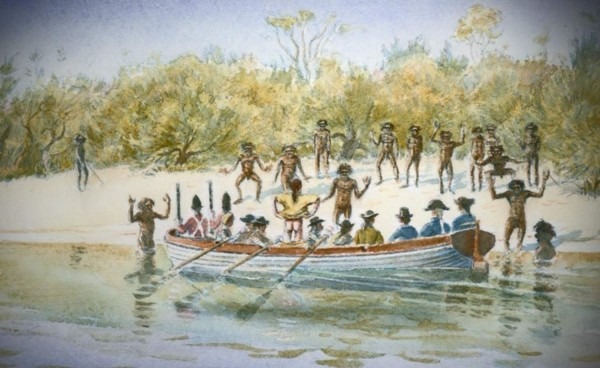
To prove the clean shaven foreign men are not women, the lad is instructed to display his manhood.
Published: 18 Mar 2024
His story commenced long before his birth and is not one of riches or privilege but one of adverse poverty. His mother was from the poorer quarters of London, given transportation for the term of her natural life, for stealing clothing to buy food for her sick child. Being unaccustomed to the art of thievery, she was soon discovered during the act then without consideration quickly before the local magistrate, forcing her to leave her first born in the care of the church with only a soiled length of red ribbon as his legacy.
Firstly the verdict was death by hanging, as the goods she stole had a value greater than twelve pence but later the death penalty had been commuted to transportation for life to the far end of the earth, where women of child bearing age, or useful as bonded servants were desperately needed in the antipodean colonial prison.
Before being transported the woman was incarcerated for almost a year in a rat infested prison hulk on Portsmouth harbour, to live with the tormented lower class of women, many plagued with insanity brought on by lengthy imprisonment, almost starvation and maltreatment. Sometimes women were simply taken from the streets without crime or charge, to be away from the eyes of gentle folk and once in the dark damp quarters of the leaky hulks the rats were often preferred company then the cruelty of their gaolers.
As he is not yet born he has no name, being conceived on board the hulk Antigua in Portsmouth harbour after his mother allowed her gaolers advantage for an extra morsel of sustenance. Eventually the child comes into the world on the vast ocean as the East Indiaman the Earl Cornwallis, made passage via Rio de Janeiro, around Cape Horne with its notorious storms, bound for New South Wales and Sydney Cove, a mere dot of existence on a vast island continent as big as Europe or North America. A land most believed to be populated by black cannibals and vicious animals of unknown qualities, not forgetting more deadly spiders and snakes then the rest of the world compiled in total.
The child’s birth was registered by the ship’s doctor some days out Sydney Cove, in sight of the long south-eastern coast of New South Wales. If he was given a name by his mother is unknown, as she passed from her squalid world soon after his birth and he was giving into the care of a wet nurse, a woman who had lost her own infant some days earlier. As he was small and undernourished, she called him Weed.
Being born to a convicted felon, Weed is neither freeborn nor is he a convict, essentially he is the property of the crown, so if Weed survived the voyage, survived the dangers of a new world; he would grow into manhood deemed by the gentry as part of society’s human waste. If there could be a positive to his future, it would be living in a world far away from the filth of London’s streets and choking pollution that Londoner’s daily breathed.
The ship Earl Cornwallis had long been lost to Lloyd’s of London’s registry and with the colony of Port Jackson, now named Sydney Town, past the peril of starvation. With those distant Blue Mountains crossed and considered no longer a barrier but a passage to the endless flat planes beyond, it was time to introduce the Southern Continent as a developing new world ready for anyone with entrepreneurial spirit.
At last the child had a name; his first was Weed Ashmyre, taken from what was wrongly believed to have been his mother’s family name and documented by one not accustomed to the name of Ashmore but once on shore and transferred with the female convicts to the women’s prison, he again became simply Weed and the name of Ashmyre was soon forgotten. Weed was a good enough title as he was passed about the women, being breast fed by anyone with extra milk, thus multiplying his immunity against almost any bug the old world had to offer.
Weed was good enough for a child who had not yet found worldly consciousness. When addressed as such, the infant would laugh and gurgle accepting it happily, as would any pet hound given a name below its worth. Once old enough to do simple work he was given the name of Tommy, sometimes Tommy Cornwallis after the ship on which he was born, sometimes Tommy the bastard or Tommy No-One, as his registered birth name had been lost when a fire destroyed the archives of the document registry at St George’s Church at the top end of Pitt Street in Sydney Town.
For a short time after passing his tenth year, Weed became Tommy Marsden when the Reverend Samuel Marsden took him on as houseboy. During such times he learned much and could saddle a horse or harness a buggy with perfection, he also learnt a little about gardening but it was the man’s fire and brimstone that cast the longest shadow over the boy and instead of bringing Tommy to god, it drove him in the direction of disbelief.
The boy then became known as Tommy Miller when the Reverend departed for New Zealand to whip religion into the Maori, and Tommy was taken on by a sergeant in the New South Wales regiment, colloquially known as the Rum Corpse and like the pseudonym of the Corpse, the sergeant was well accustomed to rum. It was during his time with the sergeant the boy realised how cruel and disregarding a man could be.
Those days had long past, now as a young man he called himself Axel, a name he gleaned from a midshipman who showed kindness and offered up a coin that had no meaning or value. He was told the coin was rare and made from silver but alas it was only iron alloy. Axel kept the coin with its strange characters as a charm, being told it held the mysteries of the Orient from a distant and strange land called Zhongguo. As for the midshipman named Axel, he spoke little English, proclaiming he came from Saxony a country deep in the heart of Europe, travelling to England after his village was burned, his family killed by Pomeranian raiders from the lands to the east of Prussia.
While self-appointing the name of Axel he wished to distance himself as far as it was possible from his past and as the female convicts who were transported with his mother only remembered she came from Southwark in London, he decided he would be known as Axel Southwark but that was too difficult on the tongue so he soon shortened it to Axel South.
Axel South was a lithe lad with the reddest hair conceivable. His skin, as white as alabaster and easily blistered if exposed to the harsh southern sun, giving his features a dusting of freckles but his slight frame had since grown taller than his English contemporaries and he was strong.
During his time assigned to Miller, before the Sergeant’s regiment was posted to the newly acquired island of Mauritius taken from the French, Axel had been put to hard work which developed his endurance. Now free from Miller and most restrictions placed on him by the colonial authorities, he collected together what little he possessed and made directly towards those distant blue mountains while disregarding the dangers of the wilderness and the blacks.
What was to be discovered beyond those craggy peaks of blue had influenced the lad’s imagination from his early years. Firstly would they ever be crossed and was China, that mystical Zhongguo, to be found somewhere beyond the flat dusty planes that stretched endlessly to the west. Possibly there was a great inland sea; even the Queen of Sheba’s lost gold mines. Some said you simply had to walk the land and pick up diamonds as large as your fist. What was a certainty were the tribes of indigenous black men who held dearly to their customs and their ancestral lands for upwards of sixty thousand years.
As a lad through Sergeant Miller, Tommy had been introduced to Gregory Blaxland, one of the explorers who eventually found a way across the mountain barrier. During that time Axel meet with Edward Buckley a young convict from some place called Devon and transported under the crime of deviancy, who had been a servant with Blaxland’s party during the mountain crossing.
Tommy had become friendly with Buckley learning many wondrous stories of what the explorers had discovered during the crossing. There were tall pillars of sandstone the natives called the Three Sisters representing three beautiful young native women who, as the story was told, the tribal magic man turned to stone so they wouldn’t abscond during a battle with a neighbouring tribe but alas the magic man was killed during the battle and no one knew how to reverse his curse.
There were also dense Mahogany forests and waterfalls so tall they seemed to touch the sky but most of all there was well watered pasture stretching endlessly into the distance almost forever and long ribbons of rivers that obviously emptied into that mythical inland sea, as nowhere on the continents western shore had their deltas been discovered.
Would I find China, Tommy had asked.
No lad, Buckley laughed, it is only the desperate believe they will find China out there. What you will find are pastures enough to hold all the sheep and cattle of Europe and room for most of its population. You will also find tribes of black men who hold precious to their traditions and land, Buckley appended as dissuasion against the boy’s dreaming.
During their brief association, Tommy enjoyed the young man’s company and much more than he would dare speak of before Buckley received his ticket of leave and departed across those mountains he helped explore. In departing Buckley obliged some essential advice to young Tommy No-One being, tell folk anything they can discover for themselves and enough to prevent them from seeking further but keep private that what is private.
At first, Buckley’s advice meant nothing to the lad but after making complaint about Miller to the sergeant’s superior officer and receiving a thrashing for his impudence, he well understood Buckley’s meaning. As for the Sergeant he simply continued with his abuse on the lad until he was reassigned away from the Sydney Town. After which Tommy became somewhat perplexed towards his position in the colony, being neither free or felon without proper guidance or vocation and in the most left to his own devices.
Sometime before the now in his life, while still Tommy No-One, he approached the master from a ship bound for Calcutta who soon discouraged him from a life at sea by announcing the only position offering for the likes of you kid, would be flat on your stomach, as the crew’s bum-boy. The master’s suggestion was enough to dissuade Tommy from furthering any thought of a life as a sailor; as well it was as the mere sight of ocean gave the lad vertigo, therefore with little else in the offering he turned to petty crime to exist.
Tommy No-One’s crime was in the most stealing food, or the occasional shirt or trousers from clotheslines, to avoid starvation and the embarrassment of public nakedness. Sometime he would be discovered during the act, receiving what was considered a thick ear or worse, or chased along Pitt Street by an irate street vendor while shouting the lad’s criminal intent for all to hear. The failed success while stealing a pair of shoes, much too large for his small feet, ended in being held at the magistrate’s pleasure but the official took pity on the lad, instead of incarceration gave him a feed and a warning, the next time he would be put with the gangs building the road across the mountains to Bathurst, or if the crime was extensive, to the mines at Coal River far to the north, or the rope.
It was soon after the leniency from the magistrate the lad realised he was no longer a child and people were considering him to be vermin, no different than the native bandicoots that attacked their kitchen garden in the quiet of the night, or rats that scurried from the visiting ships and spoiled the grain in the granary, or nibbled on anything left uncovered in the larder.
Even so the need to survive was strong in the lad and he became skilful while learning from those who described pilferage as their trade but try as he may, there was always one accusing feature ready to give him away and that was the colour of his hair. In a crowd Tommy stood out like a warning beacon on a rocky foreshore. Run as he may he could be easily tracked within the milling crowd, or within a group of rascal lads as they played havoc with the tradesmen and their street-side barrows.
After realising his identification dilemma, Tommy No-One took to cutting his hair so short it became a patchwork of fiery bristles on his skull, now instead of being described as the kid with the red hair, he became known as desert-head and remained a target in a crowd.
Even with his change of hair style the lad was plagued by a more concerning problem, being he was basically honest and hated his life of petty crime so much that on stealing fruit from a vendor he would meaningfully call an apology as he scurried away to fill his belly. Tommy’s poignant regret was so moving to one street seller, he gave the lad some of his unsaleable fruit and vegetables. Mostly the vegetables were cabbage and potatoes. The cabbage Tommy consumed raw, the potatoes he cooked in the coals of his night fire on the bank of Tank Stream, while watching the traffic make its way to the recent settlement at Parramatta, or the newly discovered fertility of the Hawkesbury River’s floodplain.
Sometime a new chum would stop to ask directions, or why one so young was about without his family. In answer to such questions the lad would tell his life’s story; of his mother’s death while giving him birth and his upbringing in the women’s prison. Sometimes the travellers took pity and offered food but never money as the colony lacked coin, instead relying on rum as currency. In the most these new arrivals came with unrealistic expectation bring with them old world practice they soon found akin to fitting a square cog in a very small round hole.
The trading of rum was well controlled by the military, so much so that whenever a ship arrived you would find John Macarthur, Major Johnson and others on board bargaining for its cargo. It wasn’t only rum that the military controlled but almost all imports and for some years there was nothing the Governor could do about the trade, as those who were sent to support him and the law were the most intrusive, from military officers to Anthony Kemp the Judge Advocate.
Tommy was aware of the tribulation caused by the military but as a young man being a free spirit he mostly kept his own company and that of the native boys, who taught him the way of the forest and how to find native food even in the leanest years. When there was little to glean from the woods about Sydney Town, Tommy would beg for work being given food in payment. One such kind hearted storekeeper often showed sympathy, giving him menial work which was paid with a few potatoes, or if possible a half quart of dried peas which Tommy soaked in water until soft and consumed without cooking. Christopher Chandler the storekeeper was himself a poor man with four young children and could not afford to give more.
It was during one such occasion while cooking his potatoes on the gentle slopes of the Tank Stream Tommy first met with Scottish Jock, a ticket of leave convict who made his living by shooting kangaroos and emus, although the large birds were rare on the coastal plain, then selling the meat to the overseers of the gangs of convict road builders.
Jock’s first words to the lad were; “whatcha’ doing miscreant?”
“No miscreant sir, nor convict but having some baked praties. I only have four but you’re welcome to share them with me.”
“It would be pleasing to join you lad but you will be leaving yourself short with such a scant meal.”
“It is all I have but you are welcome.”
Jock places his gun down and settled beside the fire then he removes a small package from his toe-sack wrapped in what appeared to be part of an old shirt. He “opens his package and offers a portion of its contents to the lad.
“What is it?”
“Do you know what an Emu is?’
“I do and have tried to catch one but they run much to fast for me.”
“Not from my gun they don’t. It is dried Emu meat and should go well with your praties.”
“Are you a hunter sir?”
“Of sorts lad; I was Gillie in the old country but was caught once too often poaching the Laird’s stags.”
“I’ve never seen a stag.”
“There is nothing more majestic in nature’s kingdom, as he stands upon a crag in the morning mist with the rising sun to his back.”
Jock drifts away into the mist of past times but is soon returned beside the small cooking fire and the readied potatoes.
Tommy offers up two of his potatoes and tries the dried Emu meat. He likes its taste and admits so but in truth anything would be preferred than nothing.
“What is your name lad?” Jock asks.
“Name sir, I have many and yet none, at first I was called Weed, then Tommy No-One, or Tommy the Bastard and when I was houseboy for Reverend Marsden I was known as Tommy Marsden, and there were others.”
“Marsden you say?”
“For a short time yes.”
“I have known the good reverent but wouldn’t like to get on his bad side, as his tongue is sharper than his flaming whip.”
“I was also houseboy for Sergeant Miller of the rum corpse before he left for some place called Mauritius. After the Sergeant departed, I was back onto the street with only the clothes I wore.”
“What would you like to be called?” Jock asks, he gives a kind smile and offers more of his dried meat.
“I would like to be called Axel South.”
“A strange name for someone England born and the name Axel is unknown to my ears but Axel South it will be and in future there will be no others.”
For possibly the first time in his short existence Axel felt human and trust in the stranger was already developing.
“How old are you lad?”
“I can’t be sure but from what I’ve been told and with simple calculation, I turned seventeen sometime in the March that recently passed.”
“Therefore Axel South how would you like to be my offsider and learn how to hunt?”
That day by the Tank Stream was the first time anyone had used his preferred name and it sounded sweet to his ears then with its sounding he knew there would be no other.
“Yes sir I would much like that.”
“Therefore a hunter you will be and a fine one I am sure and no longer Tommy or any other man’s name but Axel South.”
Many months had converged into one continuous dream for Axel. He no longer accepted his past names, gone was Weed, gone Tommy No-One and gone the fear of starvation, as now Axel felt as if he belonged somewhere. He may not have a roof over his youthful head, boards below his bare feet, not even a closet full of fine clothing but it mattered not, the sky above was his ceiling and the soil beneath his feet was his floor. As for his clothing the slops handed out by the government store to convicts was to him as fine as mad King George’s best waistcoat.
It was true Axel’s life was hard and rough but at least his belly was filled each day and his only concern being how to dodge the natives as they journeyed from their ever shrinking coastal hunting grounds, to the high mountains, to reach the vast flat planes beyond. In doing so the natives kept away from the white man’s Bathurst road as they had their own songlines to travel that had been in use for thousands of years, even before the foreigners grew together and made nations on Europe’s continent, fighting countless wars over territory. The irony had been, if Lawson with his friends Blaxland and Wentworth bothered to converse with the natives, they would have saved a lot of time trying in finding a path across those Mountains and the Bathurst road would have been established further south where the land was more undulating.
In no time Axel had become proficient with a gun, learning how to track animals, even through the leaf litter on the forest floor; he also became Jock’s eyes as they began to fail. Axel also learned the ways of the black man and some of their language. Even so caution was warranted, as many of the natives from about Sydney Town had taken to fighting back and under the leadership of an Eora man named Pemulwuy had some success, by burning crops and attacking lone travellers on the Parramatta Road and those who had settled along the Hawkesbury River, beyond the protection of the military. Now with those craggy mountains crossed with and a fine road snaking its way past the ancient sacred monuments there was strife for those who lived beyond the pale of legal settlement.
There were times when all didn’t go well for young Axel being when he found necessity to travel into Sydney Town. He was fine in the uplands leading to the mountains, or in a native canoe crossing the Parramatta River, even on the occasion the Hawkesbury but he had lost most of his ability to associate with town’s folk, as many retained memory of a redheaded lad who raided their gardens and storerooms, or stole from their street carts on market day. There was also suggestion of an outstanding warrant issued against him. Although untrue, it was enough to make folk cautious when he was about, pointing him out to others in warning as he passed them by, with mother’s calling their children from the street and play, lest they become corrupted by the very sight of him.
On one such occasion while on an errand for Jock to Sydney Town, Axel chanced upon an old adversary, whose garden he had once raided.
While walking past the property, the owner spied Axel and commenced to shout.
“I know you!”
Axel disregarded the man’s challenge while continuing on his way.
“You pilfered my turnips and by the living Christ there is warrant issued against you.”
Axel was forced to protest his innocence, “no sir, there is no warrant,” he exclaimed while attempting to continuing.
“Yes sir a warrant and I’m jolly sure of that.”
In a moment the man took Axel by the scruff, dragging him into a small enclosure at the side of his house, where he quickly secured the lad to supporting pole with a length of rope.
“I have done nothing sir,” but the lad’s protest was disregarded as the man quickens to the Phillip Street precinct to fetch a constable.
It was close on an hour before the man returned with a constable, an emancipist once transported for fraud but obviously trusted enough to be given such an important position, who on spying the wretched lad with his matted red hair, grubby complexion and threadbare clothes burst into cruel laughter, “it’s but a mongrel you have captured Mr. Rennie.”
“He is a brigand who robbed my turnips,” the man forcefully declared.
“I see no loss to your patch Mr. Rennie.”
“It was two seasons previous. What of his warrant?”
“It is only Tommy No-One and harmless; there is no warrant. Release it and let it crawl back under the rock, or rotted wood where it has been hiding during these past months.”
“No sir, I am Axel South!” the lad protested.
“By any name you aspire towards, you are still no one.” The constable reapproaches Rennie, “untie the lad.
“What of my turnips!”
The man reluctantly releases the lad.
“I see no turnips in your patch Mr. Rennie.”
“As I said it was a past season.”
“Then mark the turnips down to bandicoots, as the kid is no better than vermin and forget about your loss.”
Gary’s stories are about life for gay men in Australia’s past and present. Your emails to him are the only payment he receives. Email Gary to let him know you are reading: Conder 333 at Hotmail dot Com
15,550 views